Friday, December 07, 2007

Studying...for what?

"I ask who's going to take the weight/And y'all shrug like Wednesdays are bad for me, I gotta study"
- "G'Dang Digg" by RA Scion of Common Market

I am a student of medicine. I am enrolled in classes at a school of medicine. To whom is it a responsibility that I learn the material I am "taught"? To my school, to my future patients, to myself? All of the above?

The first semester in medical school has rapidly passed by, yet I can already feel my soul being systematically removed from my body with the same amateur precision with which I removed the heart from the cadaver. Step one, "appreciate" the heart's location within the body. Step two, feel the spaces around the heart. Step three, cut the connections to the body and remove. A human heart is in my hands and I slowly learn to name all of the parts of the object that I'm holding. But I that doesn't mean I understand it as a whole. I don't grasp how it pumped blood through this person's body during 92 years of life. I don't understand the context of the pieces...mainly what was THIS heart in the context of this person. It's a question more philosophical than physiological. Yet it is of paramount importance in my training. And it never came up in class. Am I being short-changed in my education? $200,000 in tuition (+interest) for a partial education?

And so, I quietly steal away from studying Anatomy & Histology to form my own education. A short bus ride to a 2-hour community meeting in Mattapan: $1.25 (inversely proportional to the value of the lessons I've learned). Who are these BMC patients anyways? How and where do they spend the other 99% of their time when they aren't at the doctor's? Here is the other part of my education. I can see 30 hearts beating around the room. Pumping blood through vessels to deliver oxygen and nutrients to bodies that each have a purpose. Their kids. Their spouse. Their neighbors. Their community. Our community.

Our medical school is not geared towards these educational experiences, and so medical students fight a strong current to fulfill their responsibility to learn "medicine" (the art of healing). Too often it is a losing struggle. UNIDOS (http://www.unidosboston.org) offers a chance to reclaim ownership of our education. Circumventing the bureaucracy inherent in institutional medical eduction, our collaborative can facilitate experiences in "the other 99%" of our patients's lives. Through UNIDOS we can get to know the heart in a way that we never could in Anatomy lab...while it's still beating.

Sunday, November 18, 2007

Take off your shoes...

A good friend of mine once said, "If you want to have your feet on the ground, take off your shoes."

So, here I am, about to embark on my second day of door-to-door surveying for Boston's Violence Intervention & Prevention (VIP) Initiative. My goal is to learn more about the community in which I live and about the community served by the Boston Medical Center (these are largely overlapping). Yes, the coverage is small - I've personally only spoken with 4 people about their concerns and needs for their neighborhood - but it's a solid foundation. Everybody so far cited "Drugs" and "Violence" as THE major problem of their neighborhood and then went on to talk about an increase in police presence and after-school activities as ways to improve these problems.

Yes, police presence and after-school activities have the potential to reduce crime. I imagine a stronger police presence would use fear as deterrent. Yet at the same time, I could imagine a greater police presence promoting an environment where crime might be more expected. One person commented how the police always seem to be just at the wrong place: violent crime always seems to occur a couple of blocks away.

And how about after-school programs? Why do they prevent violence (esp. drug/gang-related violence)? The common argument is that it provides safe and positive alternative activities for children and youth who might otherwise be misled to participate in negative and violent activities. How about the youth that are less able to participate in these programs? Perhaps they don't make the grade requirements. Or they don't have a parent or relative to transport them to/from these activities. Or they don't see these activities as within their realm of possibility.

I don't think these solutions as clear-cut as they are made out to be. They don't seem to directly address the ROOTS of violence: anger, frustration, saddness, loss...as a result of systemic disparities in income, health care, and general treatment. Yet, as Paul Farmer (Partners In Health) asks, "Is that statement meant to end a conversation...or to start one?" I hope that it starts many conversations. I hope that we can come to common understanding of the roots of violence. I hope that we can design and implement successful initiatives that directly address these roots. I hope the one day people can be free to live their lives in security of person and with the freedom to make important decisions about their lives without overwhelming negative influences.

So I'll start again today by knocking on one more door...barefoot in Boston (figuratively). I hope to see you out there.

REFERENCES:
City of Boston Violence Intervention & Prevention Program
http://www.cityofboston.gov/VIP/

Thursday, February 01, 2007

In my cave...

Inspired by writings of the always-original G-Tron...

I am in my cave. Crouched in a corner, my body aches from months of disuse being shocked to life at the local Young Men's Christian Association. My body aches as my essence yearns to break free from the shackles of my own mind, my personally-programmed prison. And I know why the caged bird sings.

The few who dared to enter left just as quickly. Only a few linger in curiosity. Perhaps I don't even see them. Still my body aches and my eyes have opened. I feel the mind being unlocked by the body as the neural chains are pulled by dehydrated muscles. Gatorade and potassium-rich bananas help release my mind. My support group is here. ¡Gracias mis amores! I remember now what I have to do: Heal the world, starting with the man in the mirror (thanks MJ!).

Yes, I am waking up again. The imagined burdens of medical school applications, job responsibilities, and other societal pressures become lighter as I take off the Past- and Future-tinted lenses that have captured my mind from the Present. Thanks to weight-lifting and soccer. No. Thanks to my brothers and sisters who support me; who stood by unnoticed as I crouched in my cave. I knew you were there all along.

Thursday, October 26, 2006

Back from Mexico. So now what?

OK. So, first of all, my return to the dUSA begs the question, "Is a 'Marcel in Mexico' blog still appropriate?" Do I have to change the name of my blog every time I move? Was the blog just a one-time thing? Is there something particularly special about Mexico that calls for a blog?

Who knows. But apparently I have enough motivation to write this entry post-Mexico. So here it goes...

I've been back from Tijuana for about 3 months now and the transition still feels less than 50% complete. Does that mean I'm expecting a return to a previously defined state at which point I would be 100% transitioned? Perhaps I envision a "post-Mexico" Marcel more globally aware, with a deeper knowledge of the human condition. Yet these are already true. Somehow, I've been thrown into some unforseen vortex along the way HOME. Lost in my own being, I got sidetracked and haven't been able to return. What exactly got me here, I'm not sure. I have similar knowledge and skills as before, indicated by a similar MCAT score ("35" in 2006 vs "37 "in 2003). I am now nearly fluent in Spanish and have a new understanding of the Mexican culture. But the Spanish has replaced some German and French that was previously accessible. Is this just a crisis of identity? I thought I had that resolved in college.

So do I have a goal...a direction for my post-Mexico transition? Yes!! I want to get to know myself once more. I want to re-introduce myself to the 10 year old I once was, yet I want to retain the skills, knowledge, and wisdom I have attained in 25 years. I imagine my ideal state as similar to that of the HH Dalai Lama who, I have read, carries a childlike curiousity and wonder coupled to great wisdom. I want to be in this state. But that means I have to meet the 10-year old that was inhibitively shy as well as abundantly curious and creative. That's it! Creativity. I don't feel creative. My conversations are dull. I'm trapped beneath layers of social-training, trauma, etc. And there I am, sadly laughing at the outermost skin that is so far removed from me, that I can barely feel it. And yet, I just tapped the inner voice. But there it goes again. Slipping away from conciousness. I am less than 50% acclimated. One day I hope to be 0%. Just be. No transition. Like the ferry-man taking people across the river: always present in the current flow of life.

Sunday, April 16, 2006

Happy Resurrection Day

Easter marks the reunion of Jesus' spirit and dead body after his crucifixion three days earlier. Thousands of years later, here I am on Easter Sunday I'm trying to unite my spirit with my still undead body. Yoga, meditation, healthy diet, exercise, and reflective discussion are my methods.

In my path towards becoming a doctor, I recently stumbled upon the "integrative medicine" movement where contemporary Western medicine is mixed with other medical systems (ex. Chinese medicine, Indian Ayurvedic medicine, etc.) and techniques (ex. hypnotism & chiropractic). Although these "alternative" medicine techniques are not new - they are in fact much older than our current biomedical practices - they are becoming increasingly popular in the dUS, with about a third of the population employing their services.

Why are a large number of people turning towards these systems? In many cases, modern disease (i.e. heart disease, cancer, obesity, diebetes, & chronic back pain) are not adequately treated by Western techniques (usually intake of chemicals or surgery). Unfortunately, people turn to alternative medicine as a last resort after having had many painful surgeries and/or after chugging harmful-side-effect-laden medications. In the process of undergoing "alternative" treatments, they then find success. Furthermore, it's less painful, less costly, and longer lasting.

In a greater context, this shift in practice seems to be a response to the stiff & uncaring health care system overburdened by profit-seeking insurance & HMO bureaucracies that is reflected in its practices. As most common "alternative" medicines revolve around philosophies of self-healing or natural healing, they require listening to the patient - the person - instead of listening for the prescription or surgery to come. That is, the answer often comes from within and not from without.

It seems that, as in other aspects of dUS society, we seem to look for problems and answers outside of ourselves (i.e. war in Iraq and undocumented immigration "problem"). Instead, we must also look within and question the path we are heading down. How can a country that, of all developed countries, spends the most money on health care tie for 29th place in life expectancy (UNDP Human Development Report 2005)? We need a dramatic shift in the focus of our national healthcare system. At the base of such a shift is a change in perspective from without to within. Again, I'm talking about the (hu)man in the mirror (see "(hu)Man in the Mirror" from June 29th, 2005).

As a parallel, the modern Christian interpration of a God from without that saves us from our sins through his death and resurrection must also be viewed as the result of an internal journey. Indeed, the recent translation of the lost Gospel of Judas invites the theory of release of the spirit from the prison of the body. In it, Jesus confides to Judas with regard to the other disciples, "But you will exceed all of them. You will sacrifice the man the clothes me." Scholars say that Jesus meant that by helping to kill his physical body, Judas would act to free his soul. This is similar to the Buddhist and Hindu quest for "nirvana" in which one tries to reach an absolute truth and, upon reaching it, the liberated mind no longer requires the physical body. Indeed, when Mohandas Gandhi was asked whether he was a Hindu, he replied, "Yes I am. I am also a Christian, a Muslim, a Buddhist and a Jew."

We are all on the same journey, as humanity and as individuals. One physical manifestation of this journey is health and the systems by which we, as a society, choose to address it. We no longer can afford to ignore our bodies and minds, it's too costly on our checkbooks and, most importantly, on life itself. That's why I'm sitting quietly in my room on Easter Sunday, the day of Jesus' resurrection, trying to understand who I am - today, yesterday, and tomorrow. I need to understand myselft to heal myself, only then can I begin to think about healing others.

"Every human being is the author of his own health or disease."
-Buddha Guatama Siddharta

"Natural forces within us are the true healers of disease."
-Hippocrates

"It is more important to know what sort of person has a disease than to know what sort of disease a person has."
-Hippocrates

References:
"What is Complementary and Alternative Medicine (CAM)?"
National Center for Complementary and Alternative Medicine, National Institutes of Health
http://nccam.nih.gov/health/whatiscam/

"Manifesto for a New Medicine: Your Guide to Healing Partnerships and the Wise Use of Alternative Therapies"

by James Gordon, MD

"UNDP Human Development Report 2005"

United Nations Development Programme
http://hdr.undp.org/reports/global/2005/

"In Ancient Document, Judas, Minus the Betrayal"
by Joan Noble Wilford and Laurie Goldstein
New York Times, April 7th, 2006
http://www.nytimes.com/2006/04/07/science/07judas.html

Saturday, March 11, 2006

The True Cost of Entrepreneurship

How to put together an Internet Café in Tijuana for under $5,000...

5 donated computers from father's business contact: $0.00
BUT requires having a father with such a business contact: middle class income

4 used 17" CRT monitors, XBOX, & printers found on craigslist.org: $250.00
BUT requires having computer & internet access to browse craigslist.org: $2,100 + $30/mo.
AND requires access to flexible transportation + gas: $2,700 + $100

New optical mice, keyboards, and misc. computer-related supplies at electronics stores in San Diego using Mastercard: $300.00
BUT requires US Visa or US Passport: between $90 and $150 (plus requirement for adequate salary for visa)
AND requires ability to have credit card and to pay credit card on time: financial support from parents

Building with secure doors & windows, electricity, and telephone or cable service: $600
BUT requires self-wiring, self-construction, etc.: hernia operation, hurt backs, etc.

Put together the computers yourself: $0.00
BUT requires technological know-how to put together system in a legal & feasible manner: $27,000 in university tuition

Hmm...maybe it wasn't really put together for under $5,000. No wonder there aren't more Internet Café's around Tijuana despite the MSN messenger-crazed and video-game-loving teenagers all over the place.

Monday, February 20, 2006

Setting up an Internet Café

...is what I've been up to in my spare time.

It's been a process that's evolved over the past couple of months. Why do it? I could use the extra income, I want to work on a project in which I have a large say in how it takes shape, I want experience setting up a business with social goals as well as economic ones (aka social entrepreneurship).

The Internet café, dubbed "Casa Internet," will be located in Cumbres, a resource-limited colonia of Tijuana. The idea is to give access to the latest technology and information to people who normally have to struggle to gain this type of access. Using the "waste" of San Diego high-tech businesses and our own ingenuity and creativity, my partner and I are setting up shop for under $5,000 USD. We plan to offer digital camera rentals, inexpensive digital photo processing, copying, faxing, Internet access, gaming, and free computing classes, among other services.

Beyond that, I hope to organize programs that improve access to valuable information. Where instead of making a costly trip to the bank to make phone payments, people can pay their bills online. Instead of making long-distance calls for $0.30/min, they can be made at a fraction of that cost. Basically, I hope to distribute access to information technology infrastructures that are normally concentrated in areas with physical infrastructure.

Updates forthcoming...

Saturday, February 11, 2006

Hey Baby

About two weeks ago, I attended a workshop on finding your inner child...and I did. Towards the end of the workshop, I discovered my current self from the perspective of my past self (~13 years old). Wow! I've got facial hair! My body became a cool gift. Life became precious. Joined by conscious notions of holistic medicine, this workshop revived my spirit. I am now determined again to live and make each day count. As phony as it may sound, this philosophy gets recovering drug & alcohol addicts through 10+ clean years and it's often discovered by those with terminal illnesses. Why wait until you are recovering from a fall or nearing the end of life? Take advantage of life while you can. Take care of your body. Be mindful of your spirit. One affects the other and only when the yin complements the yang can you be free from burden and disease.

Peace.

Saturday, December 31, 2005

Response to Sinjin

In response to a comment on my blog entry "Borders at the Beach"...

Dear Sinjin von Hoogstraaten,

Despite my ranting about the existence of the border fence between the dUS and Mexico, I agree that taking it down is not an immediate solution to the complex problems of illegal immigration. At the same time, instead of viewing it as a solution to the problem of "illegal" flow of people, I see it as a symptom of socioeconomic maladies that underlie these massive migrations (an estimated 400,000+ people from Mexico migrated illegally into the dUS in 2005) of human capital. In treating these illnesses, perhaps someday we will not need a fence between the dUS and Mexico.

To address some of your questions ("...why the heck can't [immigration] be LEGAL?" "Yes, terrorists can enter legally but can't they more easily enter illegally?"), let's analyze the nature of the dUS/Mexico border fence. The dUS has two land borders, one between Canada and one between Mexico. There is no fence between the dUS and Canada. Couldn't terrorists could enter the dUS "more easily illegally" across the dUS/Canadian border? And yet, despite this obvious risk, why is there no legislative movement at the federal level to increase security between the dUS and Canada as there is to add a third border fence and to increase border patrol personnel along the dUS/Mexico border?

Indeed, the dUS/Mexico border policies are largely economically motivated and only mediated through pretexts of homeland security. There are days that the Arizona border patrol is told not to go out on patrol...there is a shortage of low-wage workers in the dUS. In keeping a steady, yet hidden, flow of cheap workers into our country, we are able to afford our lifestyles of excess. 40 million strong, they tend our gardens, build our homes, cook our meals, and more. We need illegal immigrants --> low-wage, legally inivisible workers.

For these same workers to gain LEGAL access to our country, they need to show their payroll stubs, proof of home ownership, Mexican citizen's ID, and any other documents they can dig up. However, a large proportion of those that are motivated to cross illegally come from vocations and locations that do not leave paper trails, they are largely rural farmers and manual laborers. They cannot get visas to come and do needed work at minimum wages LEGALLY in the dUS, nor do "we" want them to. For economic reasons.

Unlike you, I do not hate authority. I am by nature a pacifist. However, I cannot support nor respect an authority unfounded in the reality of our world. As economic policy-maker Hernando de Soto claims, laws should reflect the systems that exist and not punish those that do not comply with an imagined idea of law and order. Our laws should recognize the low-wage workers that our economic systems depend on, instead of shunning them into silent invisibility.

Thank you, Sinjin, for your interest in issues of illegal immigration. I was surprised to find someone other than a family member or a friend reading about my personal exploits. I hope that in the future we may continue a civilized dialogue and that you might refrain from comments like
Marcel, were you huffing paint cans when you wrote how we shouldn't have a fence separating the U.S. from Mexico??!?? (You didn't say that but you sure implied it... and was it the metallic paint or a normal color?)
Funny, but a little disrespectful and shortsighted. Let me close with this question by Jean-Jaques Rousseau that I feel captures a direct and clear view of the sometimes hidden inequalities that exist in our world. It's up to you to see them.

"Are you unaware the vast numbers of your fellow men suffer or perish from need of the things that you have to excess, and that you required the explicit and unanimous consent of the whole human reace for you to appropriate from the common subsistence anything besides that required for your own?"
- Jean-Jaques Rousseau, 1775

Friday, December 09, 2005

Vacation

I'm going to "vacate" my office for three weeks this winter. One week I'll spend in Mexico City, another in Eureka, CA, and the third in Seattle, WA. I can't wait to see my family and to experience another major Mexican city.

Thursday, November 03, 2005

Just the facts...

Fact #1: She died yesterday, leaving behind two teenaged boys.
Fact #2: She was infected by HIV and died from an unattended cranial embolism.
Fact #3: She visited 3+ health clinics before procuring an appointment with a neurologist on Dec. 10.
Fact #4: On Tuesday (11/1), she was severly dehydrated and wasn't taking any HIV/AIDS medication.
Fact #5: The Mexican social security doctors told her there wasn't much more they could do for her AIDS and told her she would probably die within 3 months.
Fact #6: The new free AIDS clinic in Tijuana, meant as a safety net for those not eligible for care elsewhere, probably wouldn't have been able to give her free medication (that would allow her to live an extended, normal life) since she was covered by the national program.
Fact #7: The price of HIV/AIDS medication in Mexico is 10 times that in Honduras.
Fact #8: The North American Free Trade Agreement (NAFTA) bans the use of low-cost generic treatments in Mexico made outside of North America.
Fact #9: I am frustrated.

It is beyond doubt in my mind that she (it doesn't feel appropriate to publish her name) died not from her HIV infection nor from her cerebral embolism, but from a lack of access to health care. Treatable diseases caused her to die from un-treated social, political, and economic ills. This example should be crystal clear to everybody that something is wrong with the way we go about our daily lives. She was paralyzed on the left side of her body for over a week before passing away. With more money, she might have gotten an appointment with a neurologist and I would not need to be writing this ranting blog.

Tijuana has a nationally recognized medical school at the UABC (Universidad Autonoma de Baja California). Medical students are required to do 1 year of social service before continuing on to a residency. Then, they go on to be plastic surgeons. ¡Por favor!

Tijuana has an abundance of social work positions. The only school of social work wasn't able to open this semester for a lack of students. Instead, people study business administration, information technology, etc. ¡Por favor!

How much are the Benjamins really worth?!?! Look at the pattern of daily news clippings on secret CIA prisons, falsified documents of uranium procurement, new Homeland Security plans to close shut down illegal immigration, etc. What are we doing? Look at the problems of the world and change yourself.

Fact #10: ________(fill in the blank)______

The future is in our hands. Please help me make it a good one.

Sunday, October 16, 2005

Dreams and Memories

Today I finally finished the book "The World is Flat" in which Thomas Friedman outlines the extreme flattening -- his term for increased interconnectedness and mobility -- of the world, describing a series of "flattening events" (i.e. fall of the Berlin Wall & rising of the internet browser) and talks about the implications that the flattening world has for American society. A few interesting examples, but nothing new to those of us paying attention to and participating in the flattening. One idea, however, that caught my attention was that of dreams and memories. In the last chapter of his book, he summerizes his previous remarks about a country's political and cultural climate and their affects on willingness to change. The more a country is focused on dreams (hope for the future), the more they constructively respond to changes while the greater a country is focused on memories, the more they respond with humiliation and hatred.

Dreams and memories...it makes for an eloquent comparison. Is it true that the more memories you have (the longer you live), the fewer dreams you have? Is the goal to die with no dreams and with many memories? Who knows. I hope to die with a lot of both.

Friday, October 07, 2005

Sleepless in Seattle and Tired in Tijuana

It's nearing the end of my third week as a staff member of Esperanza. After a two week "break" in Seattle, I returned to Tijuana, only to spend more time in the office working on internal documentation and communication systems. After three weeks, that included hectic preparation for a presentation for the Board of Directors, I have to say, I am tired. Yes, I did get a small break in Seattle, but I don't think it was enough. At the same time, I was anxious to leave Seattle, to return to Tijuana and start my new job. Sleepless in Seattle and tired in Tijuana. What's the solution? I'm convinced that I need a trip to an isolated beach on the Baja Peninsula with my girlfriend before I turn loco.

Currently listening to: 80's pop/rock
Currently reading: "The World is Flat" by Thomas Friedman

Saturday, September 03, 2005

dUS vs. Mexico

On Saturday the dUS national soccer team beat the Mexican TRI 2-0 in a World Cup 2006 qualifying match. But to ignore the physicality and playmanship of the game and reduce this match to a pure score would be like reducing my experience in Tijuana over the past 8 months to a single blog entry. Nonetheless, with the goal of sharing some tidbit of my time on the pitch, I'll give you the score and a little bit more.

Since my arrival to Tijuana on February 4th, 2005, I've learned about construction, about Tijuana, about the dUS, about the human condition, and about much more. But more than anything, my time here has been a voyage down the endlessly changing river of my own person. Like the words I spoke to so many volunteers, "We can change the world by first changing ourselves." I have matured. I understand more about my relation to the rest of the world. I have better defined my goals and my dreams.

I have also been fortunate enough to witness the same growth in others. Misael, in the picture at left, often watched from the sidelines as the volunteers helped build the beginning stages of his house. But as the process continued, he took on a leadership role in his family, participating in the construction, asking questions about the technique, and inspiring his siblings and friends to join us in building his family's dream.
His is one of many similar stories I could share. Dulce, a single, working mother, learned about her own value as a mentor and motivator for the youth volunteers that helped build her home. The fact that I have learned the same is yet another piece of evidence that a human is a human...is a human...is a human. We value our friendships, we love our family, we want the best for our kids. And somewhere in our common web of values, we start to differentiate between "me" and "my neighbor." We differentiate between US and them. We force people to cross perilous desert and mountains that stretch the border between the dUS and Mexico in order to complete the same goals that we have or, like the record 415 people since Oct. 1st 2004, die trying.

These are the symptoms of our illness. The gap between the rich and the poor are increasing. The dUS spends more per capita on health care than every other country, but is ranked 27th in the UN Health Olympics. The rich in the dUS, Mexico, and many other countries, are pocketing taxes, benefits, and other products of the people. 2 billion people worldwide will suffer a pre-mature death due to lack of access to clean drinking water, while others use it to water their lawns. A country will jump at the chance to spend money to fight an oil-based war but delays in a critical response to domestic emergencies. You know how the list continues...

And then there is ESPERANZA ("hope" in Spanish). Hope in friendships, hope in community, hope in trust, hope in "love your neighbor as yourself." To have had the opportunity to help participate in esperanza for the past eight months is nothing short of incredible. I leave my experience with motivation and an understanding of the problem and of a solution. I am tired yet energized, sad yet happy, discontent yet content.
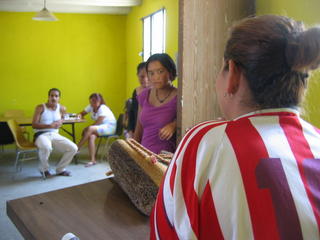
The last week of this chapter in Tijuana was filled with goodbye fiestas, mostly for my sister, Martina, for whom it is time to return to school (see picture at left) - I'll be coming home for two weeks and then returning to Tijuana for a year. Each good bye was bittersweet. They were a celebration of friendships formed and friendships that will continue for a lifetime. People that neither she nor I had ever met came to say thank you and goodbye. We talked, ate, danced, sang, and enjoyed each other's company one last time, for this time.

I hate goodbyes. There's pressure to express inexpressible sentiments. There's pressure to say things you sometimes don't feel. They are very climactic and thus, imply a subsequent denouement. I would prefer more continuity, a recognition that although we may not be in the same physical location, we as human beings will continue to be interconnected by our daily activities: breathing the same air, drinking from the same water source, using energy from the same sun. Instead of a goodbye, I envision a conscious recognition of an ever expanding understanding of our fellow earth inhabitants provided by every new friendship/aquaintance, for better or for worse.
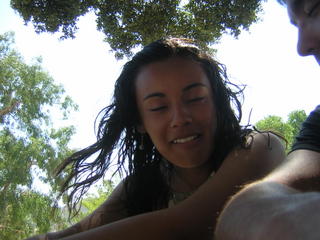
Fortunately, the fiestas were not a good bye for me, but a "see you soon." After eight months in Tijuana, I cannot deny that I have established roots. I love my co-workers, I love the lifestyle, and I am in love with a beautiful muchacha (at left). You can take El Chino out of Tijuana, but you can't take Tijuana out of El Chino. I'm returning in two weeks to continue working with Fundación Esperanza de México and with Fronteras Unidas until August 2006. It will be difficult to be away from my home in Seattle, but it would also be difficult to be away from my home in Tijuana.
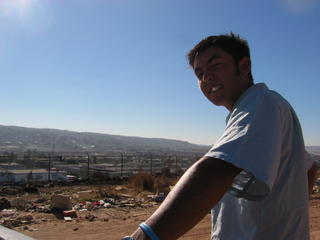
And so, now that I've reached the end of this blog entry and done a brief overview of the play, it's time to get to the score. But you know what? I just can't do that. Because it's not dUS vs. Mexico, but dUS with Mexico, with Seattle, and with the rest of the world. Scores are irrelevant. We are all on the same pitch, working towards the same goal. The more we are ball hogs the harder it is to reach the goal. The more we pass, the easier it gets. It's our responsibility to know our neighbors before waging war (both active and passive) with them. You can't wage war with friends, but you can surely sit down with them and enjoy life. Here's to enjoying life.

Until next time,
Marcel "El Chino" Tam

Thursday, August 18, 2005

Enjoying the routine

In my final weeks here as a volunteer coordinator for Esperanza, I am spending a lot of time reflecting on my time here and simply enjoying the routine to which I have grown accustomed the past seven months. Sweating, singing the latest Banda hits from "La Invasora 97.7," swinging a pick, drinking a Coca Cola at the beginning of each work day... These little things are the terra firma that have grounded my role/identity here in Tijuana.

Also, particularly special has been the inclusion of my youngest sister, Martina, in these experiences. Since mid-June, she has accompanied and often carried me through the work day. When I wanted to play soccer or spend time with my girlfriend, she anxiously took over. She often did so better than I could have. In the picture at left, she is directing a group of hombres from Xavier High School (New York, NY) how to mix cement.

It's very special for me to witness her growth, both how much she has grown since I last lived with her (4 years ago) and how much she is growing right now. Her days here are numbered (although she refuses to count them) and there are many things that she still wants to do before she leaves. We will see how much she can do.

As for myself, I am fortunate enough to have the opportunity to open another chapter in Tijuana just as I am closing this one. After a two week vacation to Seattle to spend time with my dearly missed family and friends, I will stay down here for one year more (at least until August 2006). I plan to put my Computer Science degree to good use working on two different databases - one of the volunteers and families of Esperanza and one for the public health related data for Fronteras Unidas. I am anxious to return home (although no longer in the same physical building) to be with my family.

Currently reading: "The Mystery of Capital" by Hernando de Soto
Currently listening to: Gotan Project
Currently sitting on the floor.

BTW, if you know of any high-clearance vehicles (i.e. Jeep Cherokee, Ford Explorer, pickups, etc.) for sale in the <$1000 range, please let me know.

Monday, July 25, 2005

Welcome back!


Welcome back Marcel! I missed you. The past week has been tough. I had lost all motivation to get to know the volunteers. I had lost the motivation to work. I wasn't eating right. I wasn't sleeping enough. I felt overwhelmed with tasks: need to write that med school personal statement, need to write the Esperanza job proposal, need to organize the group folders, need to plan the group activities, need to meet with Fronteras Unidas to continue the process of becoming familiar with their organization, make visual instructions for the compost pile, contact future groups about planned activities...and the list goes on.

Now, with your return, I feel like a weight has been lifted from my shoulders. Not that the "To Do" list has shrunk, but it somehow seems more managable. Thank you to my parents! Thank you to Meg! Thank you to Eduardo! Thank you to Martina! Thank you to Ana Laura! Interesting how sometimes you need to talk to other people to remember who you are.

Love,
Marcel

Tuesday, July 19, 2005

And now for something completely different

Yes, despite all of my normally serious postings, I actually manage to have a lot of fun down here in Tijuana. On June 4th, I saw "Los Tigres Del Norte" in concert (see picture at top-left). They are a legendary norteña music group that has been making music since the late 60's. Their songs strike at the heart of many people's lives; they talk about drug smugglers (i.e. "Contrabando y Traición"), Mexicans leaving their loved ones behind to work in the dUS (i.e. "La Sorpresa"), feeling trapped in the dUS (i.e. "Jaula de Oro"), about simple, unstoppable love (i.e. "La Puerta Negra"), and much more. Preceded by 6 other groups, they started playing around midnight, took a 45-min. break around 2am to sign autographs and then played until 5am. On top of that, every song that they played was suggested by audience members that wrote their dedications on slips of paper and passed them up to the stage. Now that is PUNK! It was probably one of the best concerts I've ever been to.

I also realize that I haven't written much about the work that I'm actually doing. Many of my days are spent cutting rebar, mixing concrete, digging ditches, passing buckets...or at least directing other people to do so. In the picture at left, taken by Kyla Lackie, you can see me in the foreground caught taking a turn scooping concrete out of "the canoe." I'm joined by (right to left) community members Ana Luisa, Angeles, and Lupe as well as my co-worker Graciela and her daughter Ana Laura. The smiles on their faces attest to the fact that we have a lot of fun working together. Furthermore, it portrays the typical female-dominated involvment in the community. Where are the men? Working in Tijuana, working in the dUS, or simply not there. The Esperanza program is empowering women. They are their own bosses and their own workers. I'm learning and re-learning many things from these women about the freedoms/powers I have: not needing to worry about $, being noticed/respected in a conversation without having to say a word, and having primary, secondary and higher education, to name a few.

In my time with Esperanza, ~5.5 months now, I have definitely made some good friends. Are they friends that I'll keep in touch with for the rest of my life? Some are. Do I know a lot about their personal lives? For most of them, not too much, but we have shared many smiles, dreams, and feelings. I value those experiences very much. They are the bread of my memories here.

In the picture at left, I'm hanging out with some of my adopted daughters ("mis hijas") who are telling me that their rabbit (also named "Marcel") must be sold to the pet store because their parents are afraid the dog will eat him. Good idea. Maybe I can keep the rabbit. But what do rabbit's eat? They begin to list off all of the things that rabbits can eat. I smile and tell them that I'm afraid that taking care of "Marcel" the rabbit is too complicated for me. It's better if they take him to the pet store.

Sunday, June 26, 2005

US vs. them: a look to the Future


Border Repair
Originally uploaded by MarcelTam.
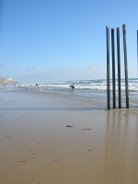
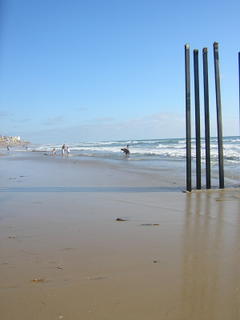
This past Saturday, I went to Playas de Tijuana and found the dUS-Mexico border fence at the beach totally dismembered (see picture at right taken by my sister, Martina). Was I dreaming? Had the beginning of a borderless future arrived? Kids jumped back and forth across the ditch in the sand that marked the division between the two countries. Fishermen followed the school of fish across the border line, joking that the fish on the dUS side were bigger than on the Mexican side. ¡Increible!

Yet, as I looked beyond the hub of activity bleeding onto the dUS beach, the white SUV of la migra (the Border Patrol) remained, ever-watchful with its tinted windows. Large steel plates lay on the sand, ready to replace the rusted ones that had just been taken down. New, taller fence posts were already put into place. Visions of a future returned to the reality that this opening in the fence was temporary.

I say visions of a future because I believe that the future is still in the hands of the present. There are many possible futures, of which I saw of a preview of only one. The prevista at Playas helped me to better understand the context of this fence. Put up in the early 1990's, this is far from a permanent structure. It's a kid just reaching puberty. Still malleable. Still culpable. Even the wall in Berlin - physically much larger and with more obvious life-threatening guardians - came down on November 9th, 1989, after 28 years of existence. How? By the will (and the force) of das Volk. They came first with protest songs, then with sledge hammers, and finally with bulldozers.

So, why is it that only 100 people turn out to a protest in downtown San Diego against civilian vigilante border patrols (google: "Minuteman Project")? Why are there no sit-ins on the beach (not a bad setting for a protest)? Why do the 4+ million people in the San Diego area (and the rest of the dUS) go about their daily business while more proposals to re-enforce the border make their way through the local and national legislatures?

Easy. Unlike the ideological border between East and West Berlin (enforced from the top down), the economically-driven dUS-Mexico border policies come from the bottom (or middle) up. They are policies that stem from our fear of change. Fear that an influx of immigrants (i.e. aliens, people that speak other languages, people with difference perspectives) will make things "worse." Fear that maybe we might have to change our way of life (i.e. using potable water to wash cars, water lawns, and hose the dog). Fear that maybe the "American Way" really isn't the goal. It's US vs. them. And by them, I mean the rest of the world.

"Fear is the path to the Dark Side. Fear leads to Anger. Anger leads to Hate. Hate leads to Suffering."
-Yoda, Star Wars

Currently reading: "Development as Freedom" by Amartya Sen and "La Cigarra y La Hormiga" (Mexican children's book)
Currently listening to: Jack Johnson, Manu Chao, Maná, Pancho Barraza, Sergio Vega and ABBA.

Monday, June 13, 2005

On Charity

Why is it that when it comes to working with the less fortunate, people seem to lower their standards? Here's an example:

At the end of each week here at Esperanza, the volunteer groups often leave some used clothing as donations to distribute to the communities with which we work. It's a wonderful gesture to re-use products in a way that might aid someone who needs a little extra help. Why then, do people donate used but unusable items like gloves so caked in cement that all the fingers are stiff or underwear with blood stains? It's Charity, not trash.

In working for an organization that's trying to build community and a dignified life for economically poor families in Tijuana, I've learned a lot about Charity. Unfortunately, the modern use of the word Charity as giving seems to distort it's original meaning as a love of fellow humanity. Charity, is really about respect, justice, and love. If I'm giving something to Charity, that should imply that I am participating in a mutual partnership. If someone is giving used, and unusable, underwear to another, it's not Charity. If one person is giving more than another, it's not Charity. Charity, giving, donating...all these things are two-way streets that many people see as two-lane, one-way freeways.

After decades of "charity," the coming of white, rental gringo vans to the barrios of Tijuana often brings blinds of dollar signs and gifts to the eyes of economically poor Mexicans struggling to live here. The metaphorical cat in the bag is that this form of charity doesn't solve any problems, and indeed causes more as the exportation of dUS band-aid policies penetrate ever deeper into the social fabric of the poor.

What I am asking for is a far-spread re-evaluation of Charity. If you are going to help someone less fortunate than yourself, you have a responsiblity to establish a relationship with them beyond the money or material things that you give. You have to teach them to fish instead of teaching them to beg for fish scraps. Doing the opposite doesn't help the cause, it only perpetuates the difference, materially, psychologically, socially, etc.. We want the receivers to become givers. So please...the next time you buy, buy used and the next time you give, give new.

"One love. One heart. Let's get together and feel alright."
-Bob Marley, One Love/People Get Ready

Friday, June 10, 2005

(hu)Man in the Mirror

Since February, I've worked with 20+ different groups totaling over 600 volunteers from all over the dis-United States: Pennsylvania, Washington, New York, Kansas, Missouri, Texas, New Jersey and, of course, California. I've met people from all social and economic levels. I've met people on the far left, on the far right, and in the middle of the political spectrum. I've worked with an 85-year old WWII vet and a 14-year old that was born when I was in Jr. High.

Of all these experiences, I've noticed a curious trend: the further away the volunteers come from, the more open they are to what they see, hear, and do here. It's a trend that crosses financial differences, social differences, and age differences. Why is it that the groups from the San Diego area (only ~45 min. away) only stay for a couple of days and the groups from across the country stay for a week? Why is it that the groups from San Diego listen to their individual iPods at the worksite and group from NY blast their music for everyone to hear? Why is it that the groups from San Diego say "I'm a volunteer, don't tell me what to do." and the group from San Anselmo, CA asks "Is there anything else you want me to do?" ? Why is it that the groups from San Diego leave their experience without even knowing the names of the families with which they worked, while the groups from Seattle, Kansas, NY, and Ohio maintain relationships with the families with whom they worked over 5 years ago?

One possibility: it's harder to try to change our own life than it is to try to change the life of someone else. The groups from San Diego live 15 miles away from the US-Mexico border. Changing their perspective of Tijuana as dirty, corrupt, and pleasure-driven means changing their perspective of San Diego as clean, straight, and righteous. Discovering the role of Mexicans as producers means discovering the their own role as consumers.

At the same time, I could just as easily ask groups from further away, "What do you do in your community?" or "How do you help your neighbor on a daily basis?" And their response would probably be similar to the volunteers from San Diego: "Not much." It just so happens that the neighbors of the San Diegans live in Tijuana and the neighbors of Seattlites live in Tacoma, White Center, Columbia City, etc. Why is it acceptable and even admirable for someone to join the Peace Corps and help build homes in the "Third World," while Tent City IV, a temporary housing community for homeless people in the greater Seattle area, sees considerable resistance by it's future neighbors. The Golden Rule comes to mind.

Perhaps I fit into this category too. After all, I'm thousands of miles from home, away from my family, away from my friends, doing "noble" deeds. Sure, I love the delicious, authentic Mexican tacos that I eat here every day, but have I ever even been to an authentic taco stand in Columbia City (<20 miles from my home in Seattle)? No.

At any rate, this is the level of change that we are working with here at Esperanza on a daily basis. The friendly conversation between neighbors, the inside jokes of co-humans, and the trust that results from the communal support of a first step; these are the "little" individual, man-in-the-mirror changes that are revolutionary. As Gandhi said, "be the change you wish to see in this world." Now, go out into the world and start changing yourself!

Paz, Amor, y Justicia,
Marcel ("El Chino") Tam